Interview: The importance of chaos with Asian Dope Boys
A concoctor of "happenings" of immense scale and form, Tianzhuo Chen is the artist behind Asian Dope Boys, bringing together an extensive supergroup including Dis Fig, Ican Harem (GMO), Kasimyn (GMO), KIM KHAN, Felix-Florian Tödtloff, City, Ndoho Ange, Lavinia Vago, Léa Djyl, OMI, Siko Setyanto, Ylva Falk, and Goth Trad. At Rewire 2026, Asian Dope Boys present, PHYSIS – an eight-hour-long work that blurs the boundaries between performance, club, concert, and theatre and treats audiences to an immersive durational experience.
Ahead of Asian Dope Boys’s performance at Rewire 2026, we spoke to Tianzhou Chen about his approach to directing and organising durational performances and how improvisation and chaos shape its preparation and unfolding. The conversation also touches on the political potency he sees in rave culture, the evolution of Asian Dope Boys as a fluid and collaborative project, and what audiences can expect from PHYSIS during Rewire’s 15th anniversary edition.
How do you relate to the role of director and organiser? And in what ways do improvisation and chaos factor into your durational performances – both in terms of their preparation and process, as well as in their moment of performance?
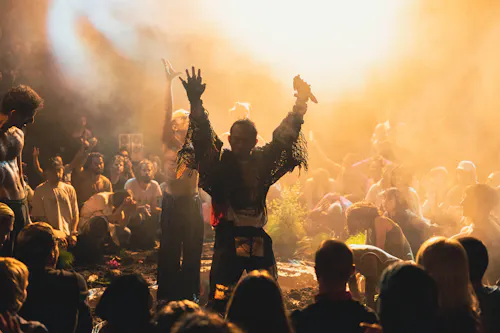
I’m not very interested in the traditional role of a director who controls everything. In these long performances I prefer to build a framework, a kind of ecosystem, but inside it there has to be a lot of space for liberty and unpredictability. If everything is fixed, it becomes theatre in the conventional sense, and I’m not interested in that. Preparation is actually very detailed – scenography, choreography, sound, characters, the visual language – but once the structure exists, the performers are free to move inside it. Chaos is important because it keeps the work alive. The body reacts differently after six or eight hours, the audience changes, the energy shifts. Improvisation allows the work to respond to that moment. For me the performance is closer to a ritual than a play. In a ritual you repeat certain elements, but every time the energy is different. The chaos is not a mistake – it’s the point.
You’ve framed your work with Asian Dope Boys as a purposeful move away from the close-minded art world. Your performances call to mind the concept of “temporary autonomous zones.” For you, what kind of political potency does rave hold which eludes art institutions?
Art institutions often operate with a lot of invisible rules – how you behave, how you speak about work, how you interpret it, in what category your identity and practice fit in. Even when they try to be progressive, the structure is still quite controlled. Rave culture is different. It’s a temporary community that exists only for the duration of the event. People enter with fewer expectations and fewer hierarchies. The body becomes the main language – movement, sound, proximity. The political potential of rave is more subtle. It creates a space where people can experience a different form of social relation, even if only for a few hours. That temporary shift in perception can be very powerful. It’s not about revolution in the traditional sense, but about opening another possibility of being together, sharing spaces and feelings in a more liberal way, it is an indirect form of resistance.
While the club can certainly be a place of extravagance and pageantry, it is for many also a sacred, intimate space where anonymity and darkness take on curative potentials. When working on one of your part-rave and part-theatre works, how do you balance intimacy with spectacle?
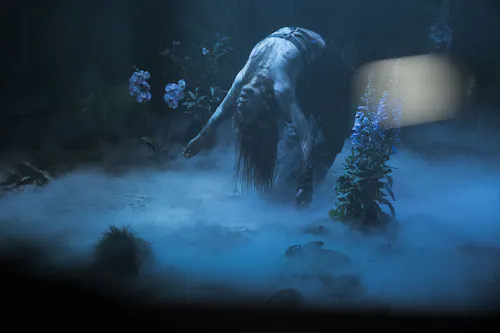
I think intimacy and spectacle are not opposites – they actually feed each other. The large visual elements or the dramatic scenography create an atmosphere that allows people to let go of themselves. But at the same time, the audience is never separated from the performers in a strict way. People can move, come close, leave, return. Funnily enough, I always start my performance with sunlight if possible, the spaces are fully planted with grass and flowers. I like the liminal space between light and darkness. Also a rave is not necessarily in the darkness for me. It is more about an illuminated situation. I’m interested in creating a situation where people feel safe enough to enter a kind of collective vulnerability. Sometimes it can be very loud and visually intense, but inside that intensity there can also be very gentle or romantic moments. It’s a balance between overwhelming the senses and allowing space for personal experience.
You’ve said in the past that you first adopted the Asian Dope Boys moniker as an alter ego because you had wanted to be a musician but didn’t feel like you could do it. What has Asian Dope Boys the alter-ego opened up for Tianzhuo Chen the artist? And how has the project mutated over the last decade?
Asian Dope Boys started almost as a joke, or maybe as a fantasy. It was just my online name on social media and I started using it as a name for throwing parties back then. Over time it became something more collective. It becomes a vessel where musicians, dancers, performers, and visual artists can collaborate in a borderless way. The name itself also plays with identity. It exaggerates certain stereotypes and turns them into something absurd or powerful at the same time. Masks, costumes, personas: all of these allow us to escape fixed identities. Over the last 10 years, the project has become more like a living organism. It keeps mutating depending on who is involved and where the performance happens.
At Rewire 2026, you will present PHYSIS – an eight-hour-long work that blurs the boundaries between performance, club, concert, and theatre. What can the Rewire audience expect from this performance? And what should they take into consideration before entering?
PHYSIS continues my interest in long-duration experiences where the audience can enter and exit freely. It’s not designed to be consumed in a linear way. People can stay for a short time or for many hours, and their experience will be completely different. The work moves through different emotional and physical states – sometimes very intense, sometimes more meditative. Music, movement, visual environments, and characters gradually transform over time. I don't want to suggest to the audience what to expect and what not to expect, or give any guidelines to enter. But it is always good to abandon the expectation of “understanding” the work in a conventional sense. It’s closer to entering a landscape or a ceremony; allow yourself to get lost inside the experience.
Asian Dope Boys present PHYSIS on Saturday, 11 April at the festival, and can be seen in conversation at Staging Ritual with Tianzhuo Chen (Asian Dope Boys), moderated by Ceola Tunstall-Behrens, on Friday, 10 April.
Photos by Nerea Coll and Camille Blake