Interview: Experimentation and play with Zoë Besuyen
Next to its annual festival, Rewire runs an education programme year-round, as well as an outreach programme which provides more accessibility during the festival, through sensory-friendly performances and workshops for people with different means and with various forms of social vulnerability. We spoke with Zoë Besuyen, Rewire's Education and Outreach Coordinator, about how art strikes a balance between self-expression, play, and communication, and how creating space allows young people and children to experiment with this.
Can you introduce yourself and tell us a bit about your role within Rewire?
I’ve been working with Rewire for over a decade. I originally started as a teacher and artist, designing workshops that brought together performance, sculpture, and music. My background is in fine arts, but I’ve also been making music throughout my life, so working across different disciplines has always been central to my practice. For the past eight years, I’ve been the Education Coordinator for Rewire, and for the past five years I’ve also been responsible for outreach. In these roles, I bring together artists, schools, cultural organisations and community partners to develop programmes for children and young people, as well as for people who may experience barriers to attending or participating in the festival.
What I really enjoy about the role is that I’m still very involved in the creative and practical side of the work. I develop projects in collaboration with other artists, and I still teach regularly myself. This means I’m not only coordinating programmes, but also working directly with participants in schools and at different locations across The Hague and the wider region. That direct contact is really important to me because it continually feeds back into how we develop our programmes and think about education and outreach at Rewire.
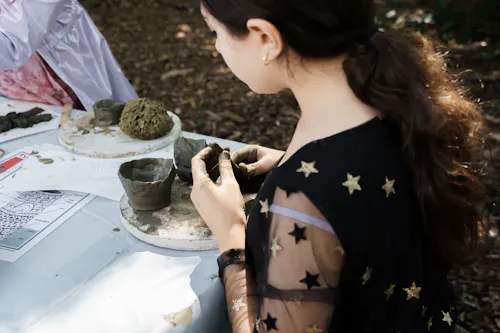
Can you share a bit about what was presented by outreach and education as part of the festival weekend at Rewire 2026?
At this year’s festival, we presented Improvising You, an interactive concert for secondary and higher education students. It was a commissioned work that grew out of a year-long research and development process with composer and artist Rafaela Andrade. The performance used biometric data from the audience – including brainwaves and heartbeats – to generate sound and light patterns, which Rafaela then responded to and improvised with live on stage. Several school classes attended the concert, and some also took part in workshops with Rafaela in the week leading up to the performance. I think that combination is particularly valuable: students don’t only encounter the finished artistic work, but get an opportunity to explore the ideas and technology behind it and engage directly with the artist.
We also continued our collaboration with an organisation from Rotterdam that develops programmes for highly gifted and neurodivergent primary-school-aged children. Around 25 children came to the festival for a tailor-made day programme. They experienced a performance and workshop with Rafaela, toured several works from our Proximity Music programme, and took part in a workshop where they built and experimented with their own graphite synthesisers. It was an incredibly rewarding project and we will be working with them again in 2027.
Within our outreach programme, accessibility is always an important focus. We presented two live performances created specifically with different forms of accessibility in mind. One was an audiovisual work developed for audiences who are sensitive to sensory information. The other, Skin Hunger, was created in collaboration with Not To Be Senseless, a platform for neurodivergent art and artists, and was designed specifically with blind and visually impaired audiences in mind.
For me, these projects demonstrate something very important: accessibility isn’t only about removing barriers to an existing artistic experience. When accessibility is considered from the beginning of the creative process, it can actually lead to completely different and artistically valuable forms of performance. The needs and experiences of a particular audience become part of the artistic language of the work.
Another outreach project took place outside the public festival programme. Over two days, in collaboration with Onzichtbaar Den Haag, we hosted festival tours and field-recording workshops for people in The Hague who had experienced various forms of social vulnerability, long-term unemployment due to health circumstances, or other forms of social vulnerability. The workshops were led by Environments and invited participants to listen to and record the city and festival from their own perspective. Their recordings were then brought together into a composition that was broadcast as part of our Radio WORM programme.
Across all of these projects, what interests me is how we can create different ways of entering the festival. Rather than expecting everyone to engage with Rewire in the same way, we work with artists and partner organisations to think about what kind of experience is meaningful for a particular group. And very often, that process doesn’t just make the festival more accessible, it also creates new artistic possibilities.
Picasso famously said, “Every child is an artist. The problem is how to remain an artist once we grow up.” While experimentation through visual arts and performance are often celebrated for children, music remains something that is often more “classically” taught. How can experimentation with and through music be made more accessible for children, and how do you envision the ways that music and sound will be shaped by the coming generations?
When it comes to experimenting with sound and music, what young people really need is space. I mean that both literally and metaphorically. Physically, we need spaces where children of different ages, abilities and needs can move freely, explore, and interact with instruments and technology without being afraid of doing something wrong. But we also need to create space within education itself. Creative disciplines are often given a relatively small window of time within the school system, while genuine experimentation doesn’t necessarily unfold according to a timetable or lead towards a clear, predetermined result.
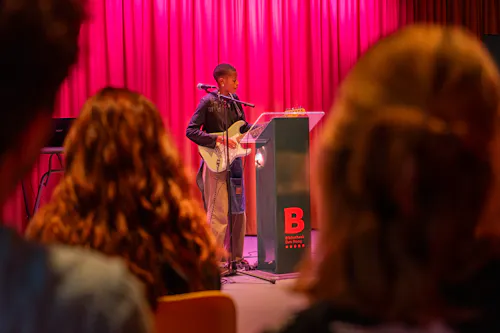
Children can initially be motivated by having a goal or knowing what they are supposed to make. But I find that they can let go of that surprisingly quickly when you create an environment in which they are genuinely free to play. And I think that’s where real experimentation begins. In many ways, experimentation and play could almost be synonyms.
What is particularly exciting now is the enormous range of tools that allow sound play to happen almost instantaneously. The young people we work with have access not only to an incredible wealth of musical history, sounds, and information, but also to very powerful creative technologies. They can record, manipulate, and transform sound, and combine music with visuals, movement, and other disciplines with a level of immediacy that simply wasn’t possible before.
I think our responsibility is to create spaces – in schools, at home, online, at festivals, and within cultural organisations – where young people can engage with those tools and ideas under the guidance of artists who bring passion, curiosity, and knowledge. And crucially, they shouldn’t always be required to turn that experimentation into something polished, accessible, or academically measurable. If we can protect space for curiosity, play, and ideas that don’t yet have a clear outcome, I think that’s where we plant the seeds for the next generation of innovative artists.
For parents and guardians of young musicians-to-be, what’s the best way they can access or discover more about what Rewire offers?
For anyone interested in participating in any of our projects, you can find information about what we do on our website. This information is all in Dutch, but we do also offer programmes in English and people can always reach out to me with my education email.
What’s the most impactful thing you’ve learned or taken away from the work that you do with the festival?
I’m constantly learning through my work with Rewire. I have the privilege of working with so many different people, of different ages, backgrounds, and experiences, and I genuinely believe there is something to be learned from every individual. That’s what makes education so exciting to me: it is never static. It’s constantly renewing itself. One of the most important lessons I’ve taken into my own artistic practice is to embrace the playful side of creation, while at the same time learning to reflect on the essence of what it is you’re actually trying to communicate. We can start with very big or abstract ideas, and the challenge is to find a way not to simplify them but to translate them. If you can translate an idea into something that is accessible, engaging, and inspiring – even for the youngest participants – without losing its complexity or essence, then I think you’ve achieved something very powerful.
Ultimately, that’s also what art is about for me: finding a balance between self-expression, play, and communication. Working in education requires me to think about that balance constantly, and it has had a huge impact on how I approach my work – not only as a teacher but also as an artist and as a person.
Interested about working on Rewire's education and outreach program 2027? Rewire is looking for an enthusiastic Education & Outreach intern to work from January to May 2027, for approximately 8 hours a week (and full-time during the annual festival). Click here for more information.
Photos by Baroeg Mulder