Interview: Distortion on distortion with Sam Slater
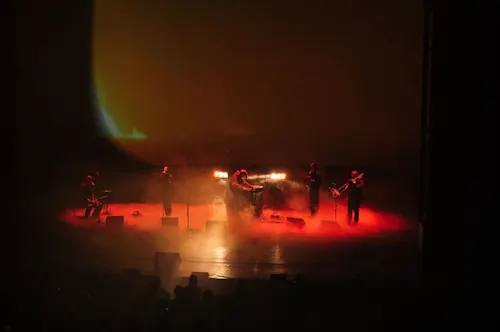
The British sound artist, composer, and engineer Sam Slater presents his new album Lunng (2026) at Rewire 2026 in the form of an audiovisual show with video from director Lukas Feigelfeld, stage design by visual artist and lightning designer Theresa Baumgärtner, and accompanied by a cast of renowned musicians from the experimental music scene: Lucy Railton on cello, Maria W. Horn on vocals, Hillary Jeffrey on trombone, Petra Hermanova on vocals and autoharp, and Andrew Bernstein (from Horse Lords) on saxophone.
Slater moved, somewhat by accident, into working as a composer on high-profile projects – such as his collaboration with Hildur Guðnadóttir on the Grammy Award-winning soundtracks for Joker and Chernobyl. Lunng sees him return to the divergent range of influences that have characterised his life-time in bands and as a producer. From the extravagant distortion of 2000s metal and the otherworldly voice of Horn, to stirring trombone swells and eerie yet warm saxophone trills, Slater has built a uniquely dark and foreboding sound world of swarming contradictions and cathartic noise.
Ahead of his performance of Lunng at Rewire 2026, as Sam Slater & guests, we caught up with him to delve deeper into its sounds and visions.
Lunng sees you returning to certain sounds that may have been side-lined or less prominently featured in some of your recent high-profile soundtrack projects. Can you talk through some of the sonic influences that went into the record? Are there any that didn’t end up making it into Lunng, and if so, which?
I was raised on a deep love of filthy metal, swirling odd-metre prog, periods of pop music climaxing in sax solos, and the most sentimental of songs. Then a decade in Berlin gave me the impression that humans only loved drones and noisy electronics – which, thankfully, isn’t true, however much the haircut might suggest otherwise. So the influences on Lunng are really the contents of my old car stereo and CD wallet before Bluetooth existed: Opeth then Autechre followed by Cyndi Lauper; Deftones, then Dvořák. The record comes from that kind of gut love – from the shared acoustic space of a rattling car interior. It’s hard to find a score that lets all of that coexist, though metal does seem to be creeping back into the cultural room again, which is a nice return. What didn’t make it in were the things that pushed the music too far into a genre lane. A couple of choral pieces got cut, and a few saxophone moments were stripped back. I didn’t want to make something clawing at modernity; I wanted a kind of sonic false memory – a summoning of a feeling I once had.
It’s difficult to separate the soundworlds you create from a sense of visuality – whether it’s a sense of colour, shadow, or hue, or even landscape and scale. While your soundtrack work has a distinct relationship to the visual, how does it factor into your album work, such as Lunng?
I’m a very visual person. I often close my eyes when listening to live music – otherwise I just end up watching the musicians play. When writing, the language is always painting: broad strokes, oils, watercolours, synthetic hues clawing at each other, painting wood versus painting trees. Lunng began visually. A few turns in the road in South-West England burned themselves into my retinas – nothing dramatic or unusual, just the shape of the bonnet, the windscreen, the ridges on the stereo knob. That car – Fabian Xavier O’Fury – and the sheer volume of strange music inside it became the catalyst for the record. The journeys were always towards something shared – a friend’s house, rehearsal, band practice. So the solo record also needed collaborators.
How do you relate to ideas of noise and coherence in your music? And how does your music speak
Coherence and noise are in constant dialogue. They’re opposing partials: noise and tone, each shaped in relation to the other. Music needs to be coherent across the x-axis – time and purpose clearly articulated. Playing for an hour to a thousand people means taking responsibility for a thousand hours of human time. The question is always: Why does this piece deserve that space? Where is it going? What is it doing? Time is the spine of composition, then noise becomes the flesh. Great music moves like a flock of birds – collectively directed, but with enough independence that individuals can drift far without breaking the whole. That’s where noise enters: the violence, the crunch, the rub; distortion on distortion, sliding timelines, stacks of almost-tuned frequencies stretching perception. If the spine is strong enough, it holds.
Watch "Sam Slater - Heatsick (feat. Hilary Jeffery)" by "Sam Slater" on https://www.youtube.com/
There is a bubbling sense of political unrest in Lunng, with some of it sounding like a warning siren howling out in the night; this is maybe most overtly referenced in “Plastic Fascist.” Can you speak a bit to what you think the potential for art (and particularly music) has to speak truth to power?
Composers are gateways to the ideas of their time – access points through which listeners hear echoes of their own fears, anger, love, and desire. In that sense, most music is political. It’s also just hard to ignore the world falling apart. Sometimes music’s politics is active: “Plastic Fascist” was a reflection on Europe’s slide to the right – the anger, the jackboots, and also the strangely energised counterforce of love and solidarity cocking its pistols in response. Sometimes it’s more passive – music behaving almost like a census, revealing which ideas resonate at a given moment. I’m an activist, a very amateur politician, and a loud voice – but also someone who spends too much time alone at a computer. Part of me is engaged; part of me is as lost as everyone else. I think that tension sits inside the work too.
Your performance at Rewire 2026 sees a number of world-class musicians joining together to present your latest album. How do you approach a large-scale collaborative show like this? And how do you relate to the role of “band leader” in such a formation?
Sharing the stage with Lucy Railton, Petra Hermanova, Maria W. Horn, Andrew Bernstein of Horse Lords, and Hilary Jeffery is pretty wild. I admire every one of those artists deeply, and still have moments of disbelief that we get to make something together. The Lunng live show was conceived with Theresa Baumgartner and Lukas Fiegelfeld around the idea that the piece could be reconfigured each time – faithful to the compositions, but open enough to invite new collaborators into it. This exact group likely won’t happen again, but we’ll bring this Rewire 2026 version to life. “One night only,” as they say. Band leadership is a tightrope. The work is in not over-controlling – keeping a loose grip on your own music. Everyone needs to feel slightly out of their depth, but completely safe in being so. That edge is where the magic happens; too much of it is where things fall apart. If it works, the flock of birds flies home together.
What aspect of your upcoming performance are you most excited or intrigued to see brought to the stage?
Being on stage with some of my favourite musicians is always a joy and a surprise. I’m pretty sure Andrew Bernstein is going to blow my mind with the saxophone parts, and Petra has been hinting at some “goth witch” tricks she’s saving for the stage.
Sam Slater & guests perform Lunng at 21:25, Friday 10 April in Amare’s Concertzaal as part of Rewire 2026.