Cevdet Erek
Ꜵccident Grotesque
Presented by West Den Haag
West Den Haag presents ‘Ꜵccident Grotesque,’ a large-scale solo exhibition by Istanbul-based artist Cevdet Erek. For this exhibition, Erek transforms the former US embassy into an installation in which rhythm and architecture attune through sound, timing systems, and graphic displays.
Erek’s practice is rooted in the inseparable relationship between space and sound. Visitors are actively engaged in both the form and the sonic character of the environment. For Erek, rhythm is not merely a musical concept but a way of perceiving the world – a means of connecting space, time, and movement. For West, he has developed a spatial system that spreads across rooms and office spaces. A continuous beat moves through the modernist building and physically guides the visitor, allowing the architecture to be experienced not only structurally, but also sonically and visually.
The embassy building was completed in 1959, designed by Marcel Breuer. Erek draws on this period by taking inspiration and sound samples from an early drum-machine, the Wurlitzer Sideman, developed in the same years. “Ꜵccident Grotesque,” written with a specially designed Ꜵ-ligature, refers to the history of the architectural design by Breuer, during the height of modernism and economic optimism. The ligature gains additional resonance, allowing to shift between vowel sounds and between accident and occident, two words that trace back to the Latin root cadere (to fall), with occident, referring to the setting of the sun. Erek uses the ligature to reference the West and the paradoxes of progress and power.
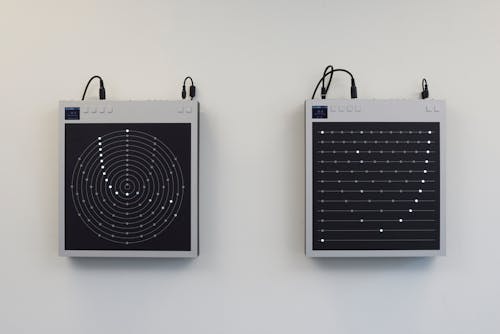
The work develops ideas from recent projects by the artist, including Rampa Rítmica (2025) at the 36th São Paulo Biennial, where a short, shared duration was divided in twelve different ways and distributed along the external ramp structure of Oscar Niemeyer’s Biennial pavilion, through loudspeakers, and appeared as a visual score on a large banner placed on the façade. The exhibition’s works – Fluctuations of Raw Techno Material (2024) and Day (2014) – introduce multiple timing systems within the former embassy building in which each floor plays its own rhythmic role. At West, two new twin sequencers built in collaboration with The Hague based instrument maker and creative-coder Rob Bothof generate and display a timing structure that is spread across the offices of the former embassy.